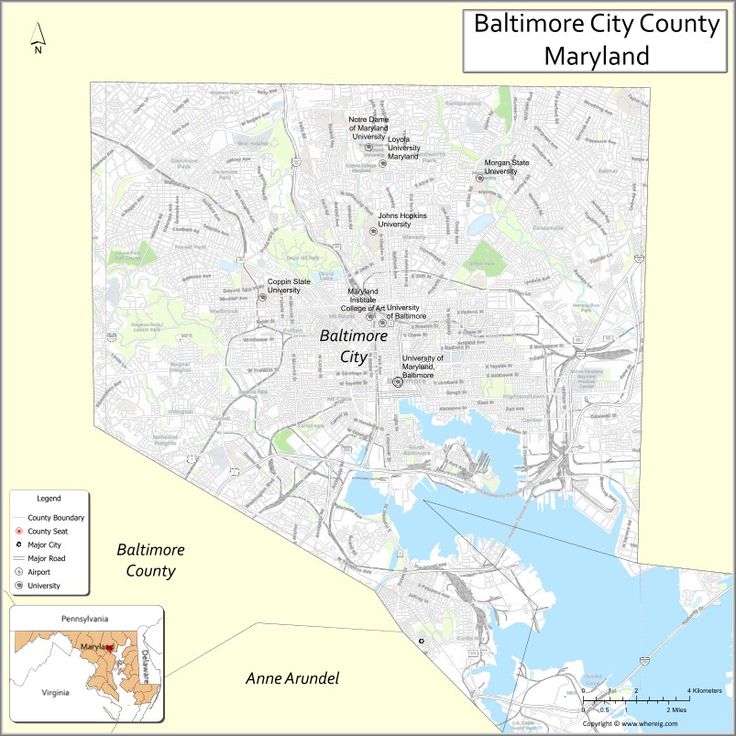
Maryland's largest city, Baltimore, is nestled in the central region of the state,, making it the perfect geographical midpoint between the state's capital, Annapolis, to the south, and the city of Cumberland to the north.
Baltimore's strategic location, at the fall line of the Patapsco River, allowed it to flourish as a major seaport during the 18th and 19th centuries, playing a significant role in the growth of the United States.
The Charm City's Strategical Position
Baltimore lies approximately 40 miles northeast of Washington, D.C., and just north of the Potomac River. This proximity to the nation's capital places Baltimore in the Baltimore-Washington metropolitan area, one of the most populous regions in the U.S.


Baltimore's location along the quiet Chesapeake Bay, which meets the Atlantic Ocean, has greatly influenced its shaping as a cultural and economic hub.
Key Neighborhoods Along the Waterfront
The city's waterfront is lined with diverse neighborhoods like Fells Point and Canton, which have grown into vibrant districts filled with restaurants, shops, and attractions. These neighborhoods are also home to historic sites, such as the Fort McHenry National Monument and Historic Shrine.


The waterfront area also includes the growing Harbor Point district, home to the Under Armour global headquarters, and the Fell's Point/Canary Wharf waterfront development.
Convenience of Travel to Nearby Cities
The Baltimore-Washington International Thurgood Marshall Airport (BWI) is a major international airport that serves the Baltimore-Washington area. Its location, approximately 10 miles from the city center, provides convenient access for both Baltimore residents and visitors.
Baltimore's light rail system, known as the Light RailLink, transports passengers between the city and BWI. Moreover, Amtrak and MARC train services offer additional rail connections to nearby cities like Washington, D.C., Philadelphia, and New York City.


The City's Rich History and Landmarks
Baltimore, founded in 1729, is rich in American history. Its strategic location by the water made it a significant port during the early colonial period.
History buffs can explore notable sites like Fort McHenry, the birthplace of the American national anthem, and the USS Constellation, the last all-wooden U.S. Navy warship still afloat.
Historical Landmarks within the City Limits
Other historical landmarks within Baltimore's city limits include George Washington's Mount Vernon estate and museum, and the Westminster Burying Ground, the burial site of famous Americans like Edgar Allan Poe, Francis Scott Key, and Johns Hopkins.




The National Shrine of St. Elizabeth Ann Seton, located in Emmitsburg, Maryland, about an hour northwest of Baltimore, is also worth visiting for those interested in Catholic history.
Baltimore's Diverse Cultural Scene
Baltimore's location has fostered a diverse cultural scene. The city is home to the world-renowned Maryland Institute College of Art (MICA) and the Peabody Institute, one of the oldest music conservatories in the United States.
Baltimore's prominent arts and culture scene also includes renowned museums like the Baltimore Museum of Art, the Walters Art Museum, and the American Visionary Art Museum, reflecting the city's creative spirit and its unique character.
Baltimore's rich history, strategic location, and vibrant cultural scene make it an exciting city to explore, with plenty of opportunities for both locals and visitors to discover and enjoy. So, whether you're planning a weekend getaway or a longer stay, Baltimore's central location makes it an ideal starting point for your Maryland adventures.